
Transfigurations
Reflections on Medieval Art 1

I’ve been thinking a lot lately about the concept of transfiguration.
The Latin preposition trans of course means movement and change — across, over, beyond, through. We can use it to think across times, bouncing the medieval across to the modern and back again, finding the resonances that let diverse periods and places speak to each other in ways that would certainly surprise, but also likely make sense to, the people in question. This aspect of the concept is explored in a really smart and engaging collection of essays I’m reading called Trans Historical: Gender Plurality before the Modern, edited by Greta LaFleur, Masha Raskolnikov, and Anna Klosowska (2021), which presents, in the editors’ words, “the wonderful heterogeneity of gender experience across time, space, and positionality” (14), troubling and exciting the boundary between binary poles.
This plucking at boundaries to create and listen to resonances between seemingly disparate areas is also what Isaac Jean-Francois and I are trying to do in our book Black/Medieval, which is generating so many of the thoughts that wind up in my Substack (including this piece). In our chapters we talk a lot about figuration — the ways that artists, in various media and far-flung contexts, make use of human bodies not so much to reflect an existing external reality but to create meaning within their own pictorial worlds. A representation, in this sense, might point to something outside itself. A figure is its own thing.
To trans-figure is to set an image into motion. What is changed is appearance, an outward manifestation. It is not to trans-form, which is more like changing the shape of something in an enduring way. The shift from caterpillar to butterfly is a transformation. The shift of a butterfly’s appearance as it moves from rest into flight, or of the colors and luminosity of its wings when it expands them in the sunlight, is transfiguration.
Transfiguration in this sense is something like improvisation in jazz, a connection Isaac and I are exploring in the chapter we’re working on right now. But the word is also on my mind because it’s at the forefront of the tragedy unfolding at the Holy Monastery of St. Catherine’s at Mount Sinai in Egypt — a religious institution that has been in continuous use since its foundation by the Byzantine emperor Justinian in the mid-sixth century, and a place that’s been lodged deep in my mind and heart since I spent three unforgettable days there this past January.
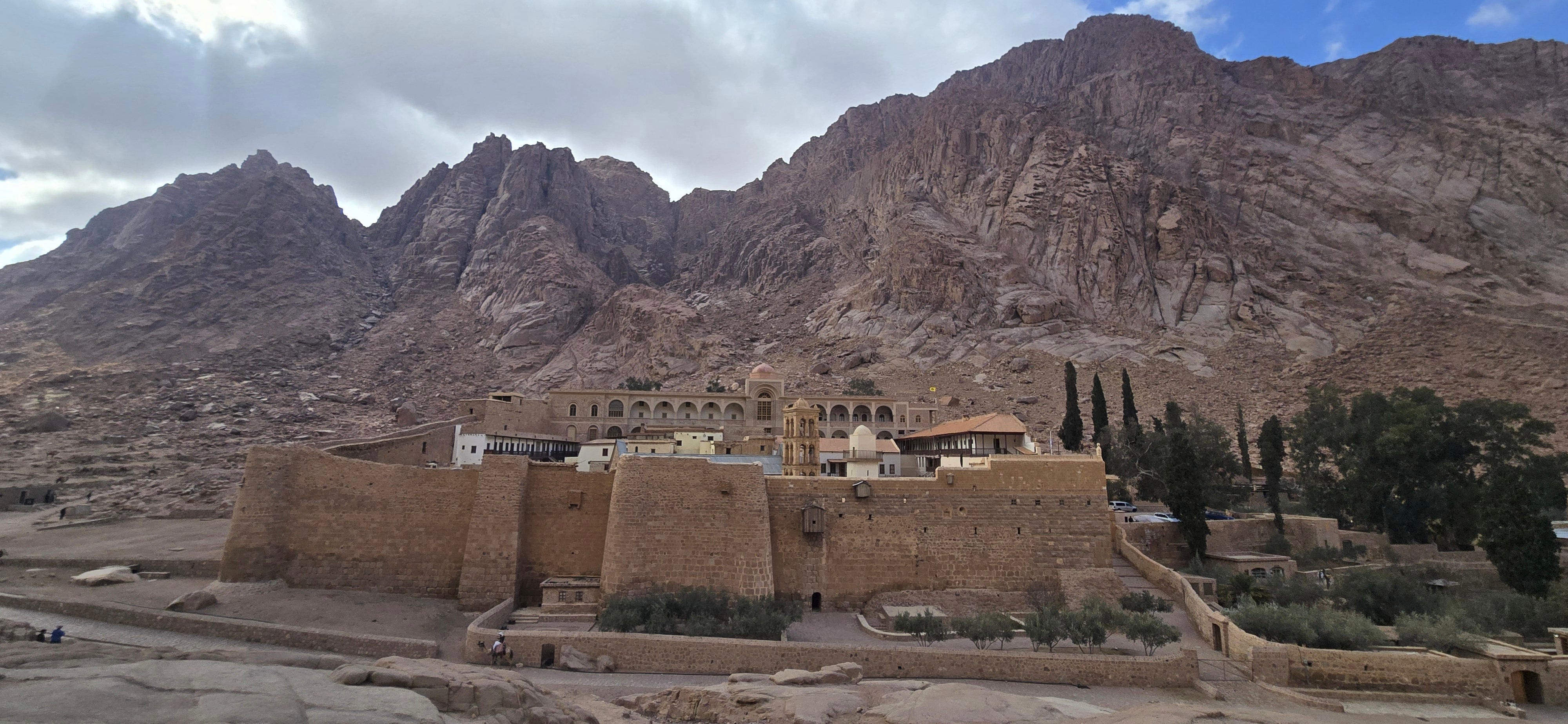
Before the translation (aha!) — that is, the carrying-over — of the relics of St. Catherine of Alexandria to this place in the eleventh or twelfth century, the monastery was named for the Theotokos (Mother of God), but the church at its center, where the liturgy is performed, is named for the Transfiguration. That naming in itself is something of a transfiguration: The human Jesus revealed his divinity to his closest apostles at far-off Mount Tabor, in Judea, but the sacrality of the mountain let it reverberate with this mountain cluster in Egypt. This, after all, is the place where God spoke to Moses through the Burning Bush (a large shrub still grows, and is honored as such, deep inside the monastery walls), and a nearby mountaintop is where God handed Moses the Ten Commandments.
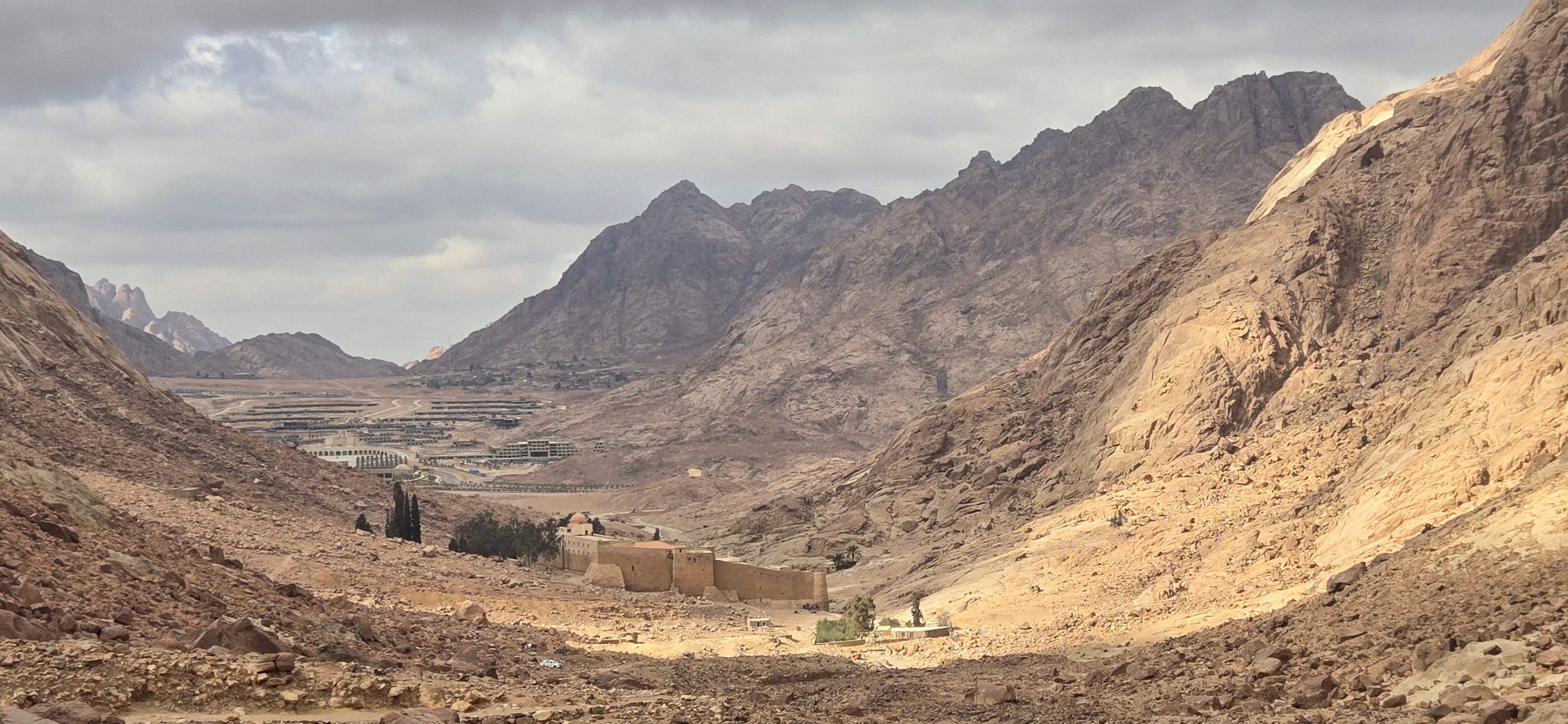
In the broad valley just past the mountain zone — the very area where the Israelites danced around the Golden Calf, sparking Moses’s ire — the Egyptian government is building an enormous tourist complex of malls, luxury hotels, etc that will destroy the solitude and peace of this ancient space of withdrawal and turn it into a venue for consumerism. To add insult (and mockery) to injury, they’re calling their incursion “the Great Transfiguration Project.” (You see the state of that valley at the left-hand side of the image below, which I took in January 2025.)
It is a transformation of the worst kind — an act of destruction, the murder of age-old cultural and spiritual heritage for base money. It’s a stunning display of greed, desecration, and idolatry at once, a vicious strike against nature, history, and the sacred. I’ll write more about that another time.
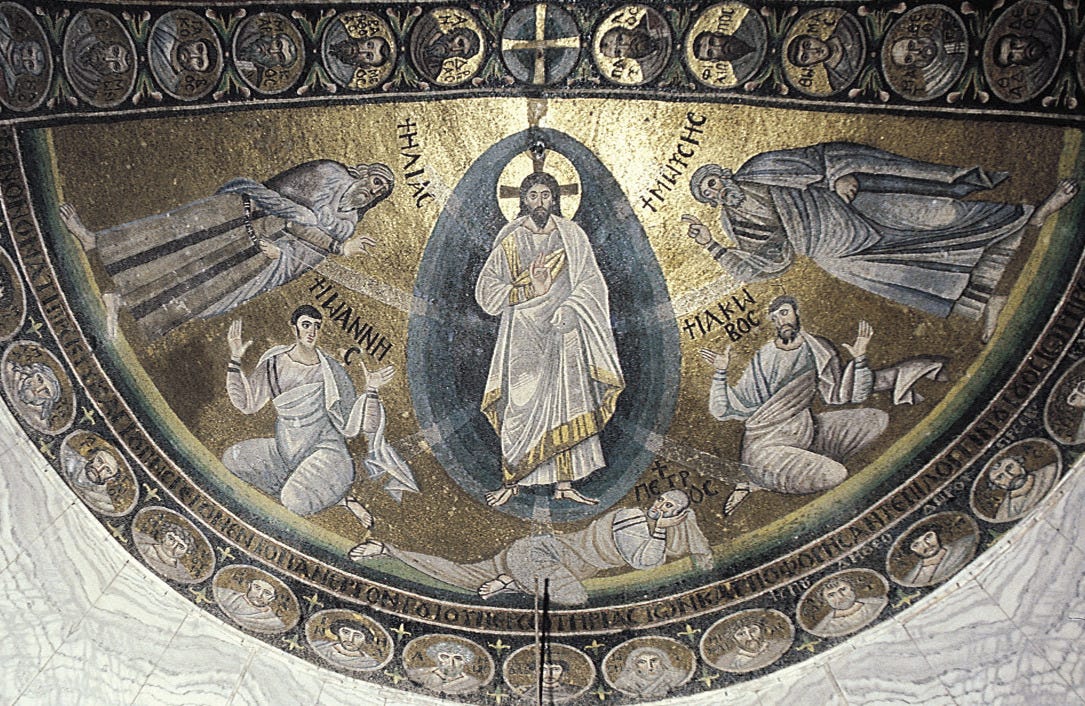
My focus here is on uplift — transfiguration in the generative, shimmering, world-building sense. This is what was pictured in the great apse mosaic that crowned the altar area of the sixth-century basilica church, at the heart of the monastery complex, which you saw at the head of this page. But before we look more closely at that, I want to think about the story it brings to our eyes. Let’s look at the biblical tellings that medieval people knew. (Below I’ve adapted (just putting into less archaic words) the Douay-Reims translation of the Gospels. This is the English rendering of Jerome’s late 4th-century Latin translation, known as the Vulgate, of the Hebrew Scriptures and Greek New Testament, which itself put into Greek the Aramaic speech by which Jesus and the apostles spoke to each other. The words have been transfigured several times over.) Here is my composite version of the three Synoptic Gospels’ accounts of this central moment of Christ’s life — in Matthew 17, Mark 9, and Luke 9 — with the variations indicated in different fonts.
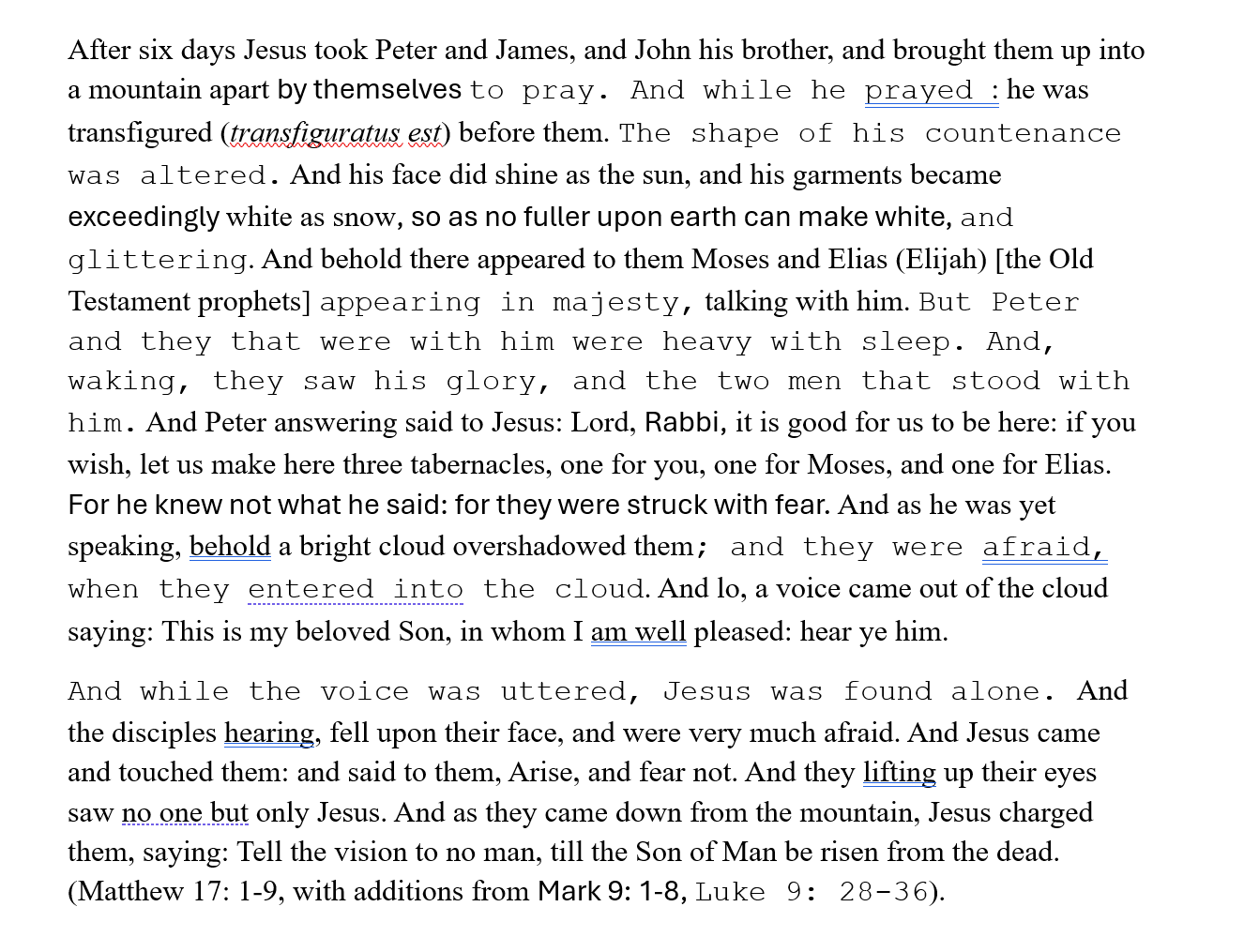
This is a lot. To be sure, Peter had just, a week or so earlier, declared his belief that Jesus was “Christ, the Son of the living God,” and Jesus’s own speeches to them were becoming more and more strange and apocalyptic, focused on his impending death and resurrection, and things at the end of time, his grim certainty that he would fulfill Old Testament prophesies (Matt. 16: 16-28). Still, Peter and the other two apostles had no idea what was in store for them when they joined their friend to hike up the mountain.
Transfiguratus est, the narratives say — he was transfigured. The Greek word Mark and Matthew used was “metamorphoō (in the passive: metamorphoumai),” which English-readers will readily recognize as “metamorphosis.” As the biblical scholar Philip Sedden notes in a fascinating essay, this word would have struck early readers as strange, for in pagan literature it was more commonly used to connote feats of trickery, disguise, or seduction, as when emperors would dress up as gods or gods adopt the bodies of animals. It’s the only place in the Greek New Testament where this word appears, and the same holds true for transfiguratus in the Latin Vulgate.
In this story, though, Jesus does not change shape or substance, as Zeus/Jupiter did when he turned into a bull or a shower of gold; he was not transformed into something else. His appearance changed into something new to beholders, and then returned to its usual state. The presence of the witnesses was key. Transfiguration here is a matter of appearance, a performance for an audience who sees and marvels. Yet it is not superficial, like a magic trick or a costume. This metamorphosis, far from concealing the truth about the subject, reveals it: the human Jesus’s true nature as God’s son, the Christ, which the apostles had hitherto sensed, more or less, but could not know for sure. So in the end, having seen, heard, and felt the effects of Jesus’s divinity, their perception of him was transformed definitively. They knew something afterward that they didn’t before.
Up on Mount Tabor that day, there was no escaping the proof. It was not just a matter of seeing and believing. The transfiguration of Christ’s physical appearance was accompanied by another wild visual spectacle, namely the appearance of the two Jewish prophets Moses and Elijah — who had both been active at Mount Sinai — and by sonic effects: the (unrecorded) speech of Jesus with these two ancients, and then the voice of God, booming forth with the same words of approval he had used when his Son was baptized in the river Jordan. Other special effects came into play, like the cloud, both bright and impenetrable, that concealed the transfigured Christ and prophets from view, and then, like a magician’s scarf, dissolved to leave just the one man. All these sights and sounds had a kinetic, visceral effect on their audience. The disciples seem to slip in and out of consciousness; they are terrified; they fall down. They are revived by the touch of Jesus, proof that their friend is back in his regular physical body.
I’m fascinated by the fact that Peter’s first response, in his stupor, is to propose building shrines to the three men. This is repeated in all three accounts. Transfiguration of the body leads to recognition of divinity, which leads straight to the impulse to create — to commemorate this fantastic and unexpected moment of change, of sensory overload, by fashioning a physical object that would somehow both honor and harness these supernatural figures. What would the tabernacles have looked like?
We cannot know the answer to that, but the texts do give a glimpse of what the transfigured Christ looked like. His physical shape and facial features (which are otherwise never described in the Gospels) did not change, but their appearance was marked by a sudden brightness: his face, Matthew and Mark say, shone like the sun, and his garments — which presumably were simple, undyed linen — became bright white and luminous. It was the clothing that particularly impressed them. The Latin terms for the resplendent garment were alba (white, in Matthew), albus et refulgens (white and radiant, in Luke), and candidus (a shiny white, in Mark). Both Matthew and Mark explicitly liken the garment to snow — a strange and unexpected thing itself, in a desert context — while Luke adds a term for glittering or radiant. Whiteness and brightness – shine, glimmer, sparkle – go together.
Dr. Sedden’s discussion of the Greek vocabulary is especially interesting here. He explains that Mark is the only writer to use “the verb stilbō (9:3) of Jesus’ clothes becoming a gleaming brilliant white” in this scene; it is the only appearance of this word in the entire New Testament. It appears in the Old Testament book of Ezekiel 40:3 to describe a man “whose appearance was like that of glistening bronze.” So it is the sheen and sparkle as much as the color that he is trying to evoke. But the color is important: Mark goes on to use “the word gnapheus (launderer),” which the Douay-Reims translation renders as “fuller,” to make clear that the garment has become preternaturally white and bright. “Bleached linen,” Sedden adds, “was expensive and fashionable, and predominantly the colour of the priestly vestments and Temple worship in general.” It was not what wandering street preachers would have worn. Transfigured on the mountain, Jesus’s face shines like the sun and his body is doubly wrapped in radiance, first by his garments and then by the luminous cloud. When the cloud arrives, the witnesses can no longer see.
And this is fitting, because after the prophets depart, and the cloud disappears, and Jesus sheds his glow, he first touches them — an assurance that his body is real — and then tells them not to report what they have seen. Their vision must stay internal until he has left the earth. It returns, of course, in these three Gospels narratives. The texts themselves transfigure the experience by putting the apostles’ astonishing — and fleeting — visionary, auditory, and kinetic encounter into written language. And the experience is transfigured yet again when it is rendered in visual art.
How to convey pictorially an event that was both about the departure from normal appearances, and meant to be kept secret? Early artists found some brilliant means. One option was to bypass the whole question of sensory experience by presenting the event obliquely, in signs that would be recognizable only to insiders. This is what the designers did at the church of Sant’Apollinare in Classe, just outside Ravenna.
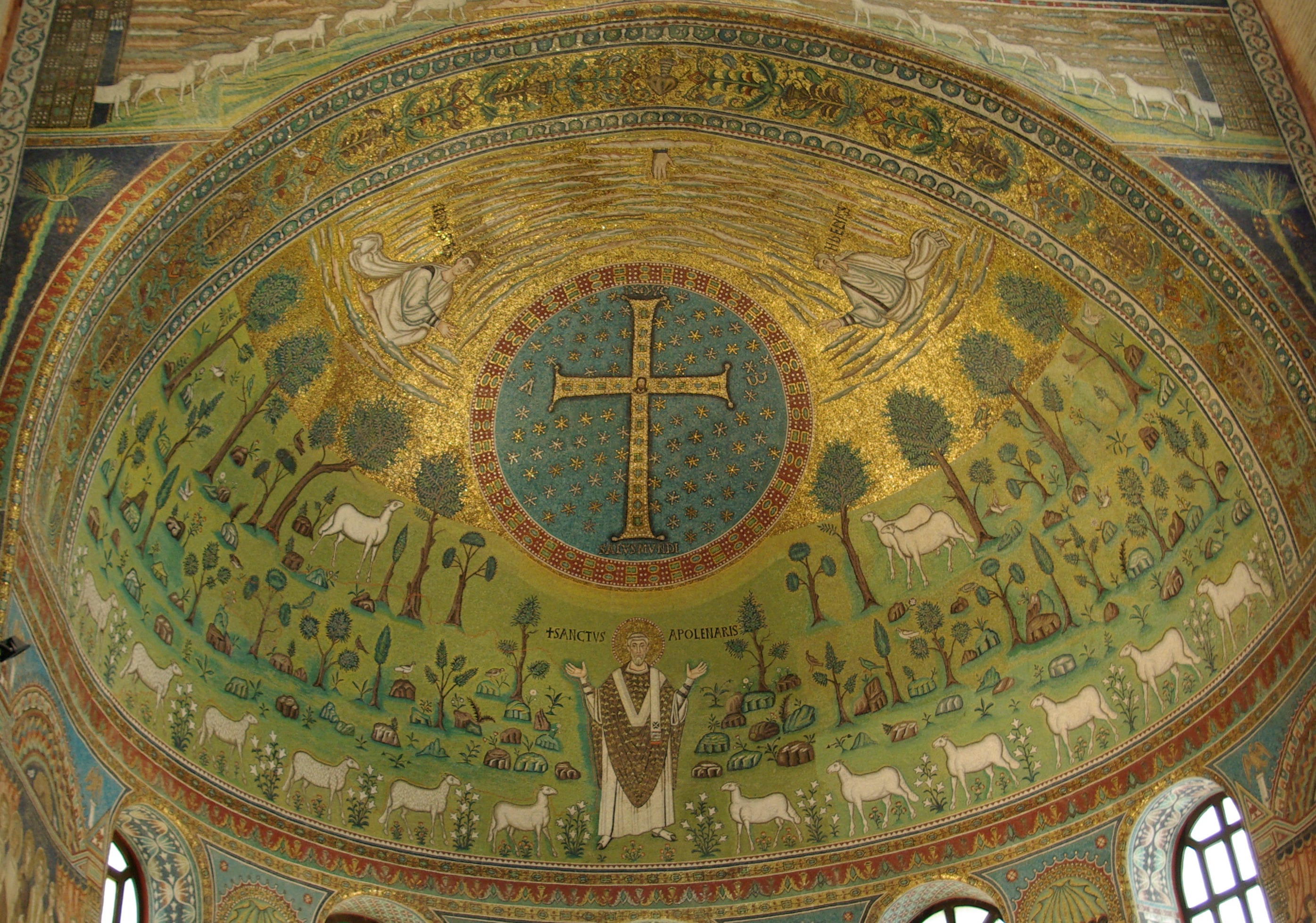
In this enormous apse mosaic, fashioned by the time of the church’s consecration in 549, the building’s titular saint, Apollinaris, takes center stage. Dressed in episcopal (bishop’s) garb and with his hands uplifted in an orans (prayer) gesture, the holy man welcomes his literal flock of sheep who approach him from both sides, through a verdant — and distinctly flat — natural landscape. Formally and iconographically, he mediates between the living priest who would stand at the altar below — and who, when he faced the public to bless them with upraised hands, would appear as a living version of the ancient saint (a point Vladimir Ivanovici has elaborated so brilliantly in his book Between Statues and Icons) — and the giant jeweled cross hovering over his head.
It’s hard to see from the ground (as it should be!), but the center of the cross is marked by a tiny, bearded face: the icon of Christ. It’s barely bigger than the simulated gemstones set into the golden bars of the cross. It glimmers against a bright blue sky strewn with stars, and a pair of letters at the ends of the arms: Α and ω, alpha and omega, signalling God’s status as all-encompassing. That point is reinforced by the circular crown of red and gold bands that holds the cross and the firmament against the shimmering golden sky beyond.
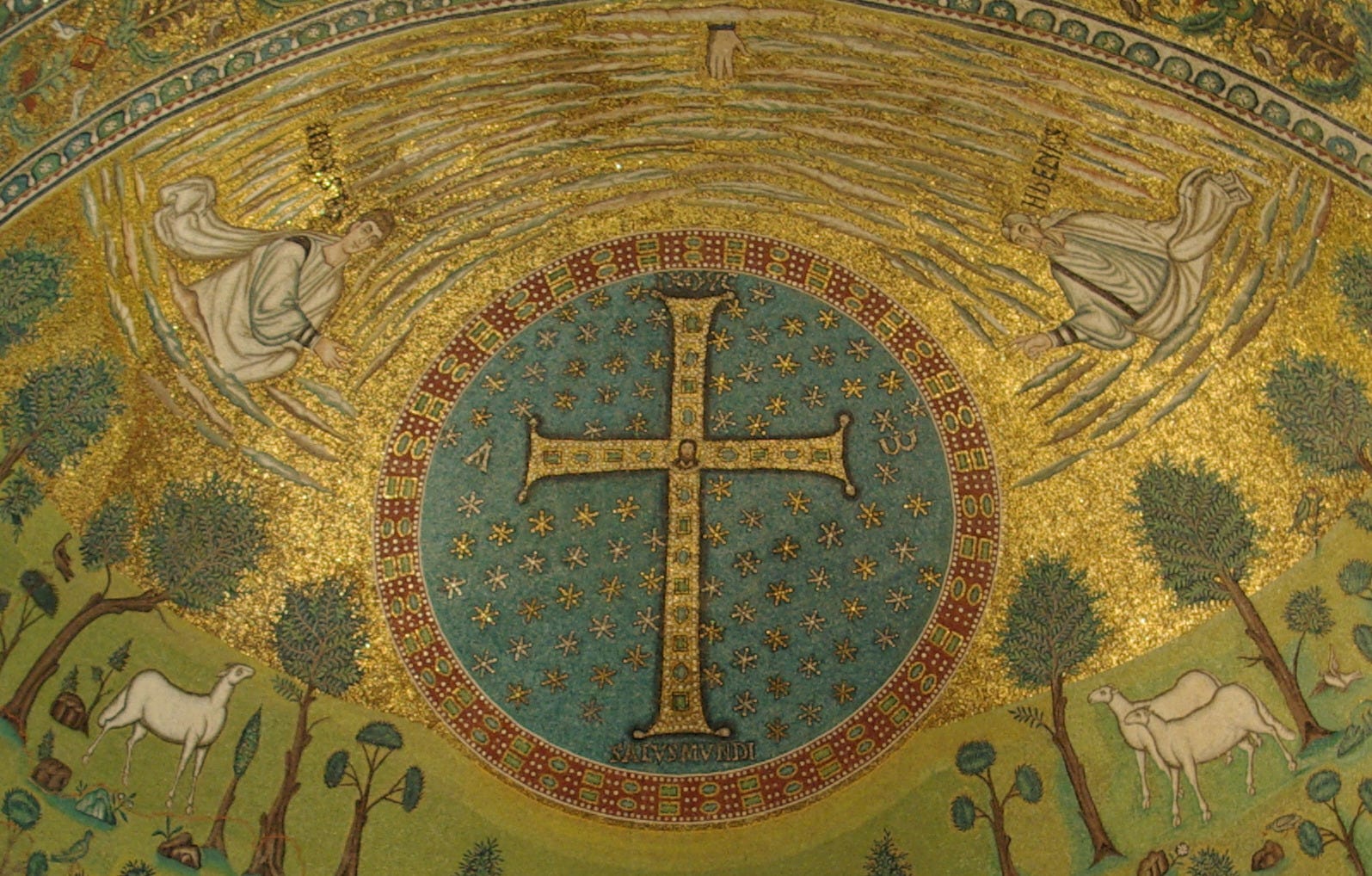
Above the visionary cross, through the gleaming golden tesserae and the wispy lines of clouds, a human hand extends downward from the apex of the arch: God’s own (immaterial!) hand, acknowledging his Son. And to either side two bust-length male figures, one old and one young, lift their hands in what look like spontaneous gestures (especially when compared with Apollinaris’s), their bright white garments billowing out behind them. Captions identify them as Moses and Elijah — the only unambiguous clue that what we are seeing is the Transfiguration of Christ. The three sheep who stand below, gazing attentively up at the cross, must, then, be Peter (on the cross’s right side, aptly), and the brothers James and John.
The artists at Ravenna have taken the opportunity not show much to depict the Transfiguration as to create one. And by trans-figuring the scene, they have followed Christ’s request to “keep these things hidden.” It is an image of reversals. The setting is a meadow, flat and fertile. The human characters have been trans-formed, metamorphosed, given new bodies — apostles have become sheep, Christ a glittering cross, the kind you’d find on a well-furnished altar. There is no white color in the Christ/cross, but plenty of shine and glitter — while, conversely, the prophets’ garments and, even more, the sheep’s coats gleam bright white. The image, in its symbolic play, requires beholders to tease out its meanings — to see the story within and beyond its symbols. It makes the multisensory, embodied event into a shimmering play between ocular vision and the discerning mind.
Other early artists took a more descriptive and direct approach to the episode, situating us as the lucky observers of Christ’s self-revelation. Here again is the rendition made for the Mount Sinai monastery church, back in the mid-sixth century:
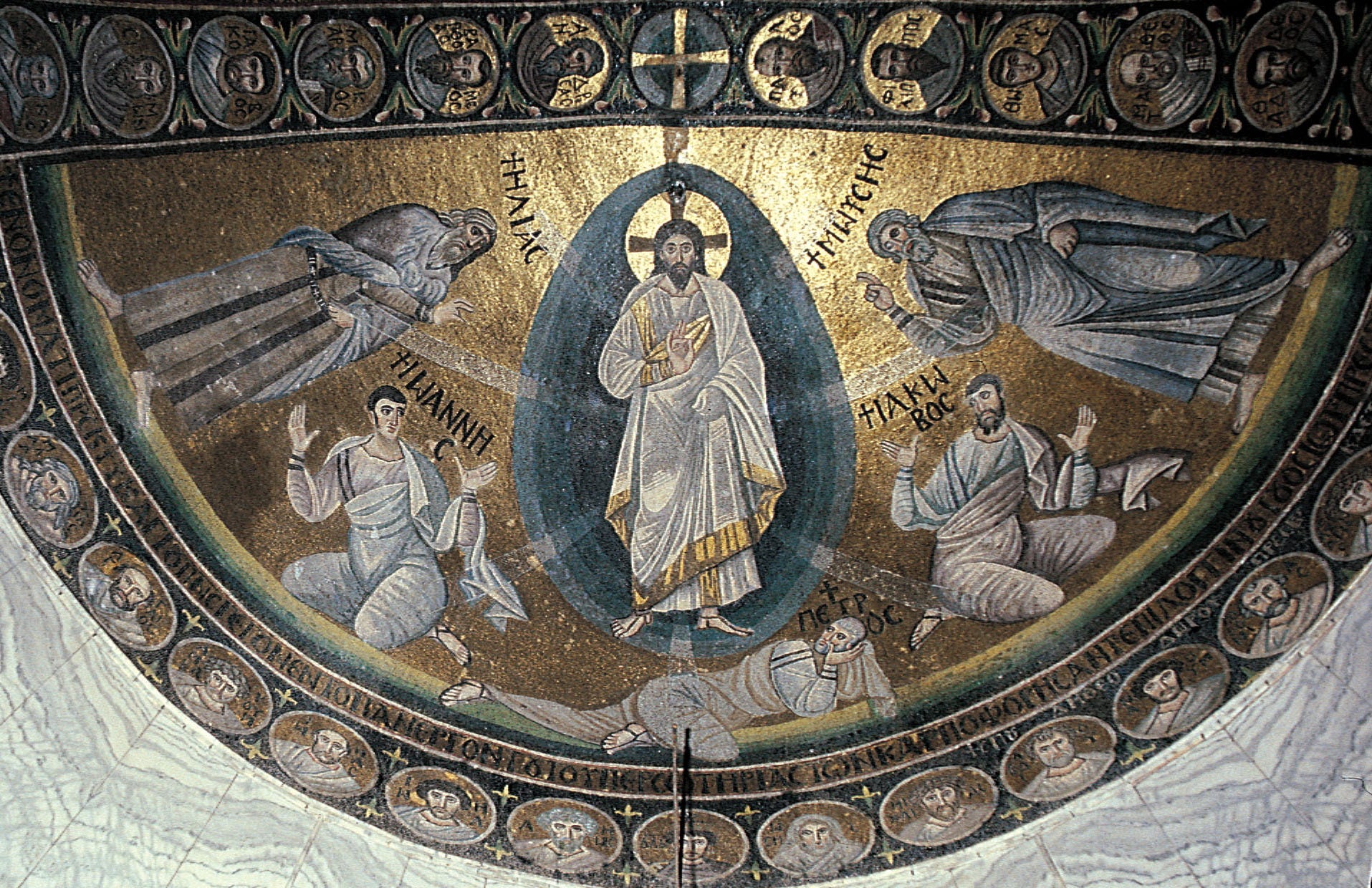
There we have it, all the parts we might expect. Except, of course, for the mountain! It seems that was not necessary to show it because we were there, in the shadow of Mount Sinai, where Moses and Elijah themselves had walked, and thus a biblical parallel with Mt. Tabor. The three apostles, all identified by their Greek names, crouch or sprawl on the flat ground with gestures of shock and amazement. To either side, the venerable elders stand firmly on the ground, pointing and looking toward the center. The ambiguous nature of these two prophets in the textual accounts, and the distinctly ethereal, visionary quality of their presence that we saw at Ravenna, is denied here; they are shown quite clearly as corporeal presences, their clothing hanging heavily from their arms and their bare feet overlapping the ground line.
And at the center, of course, is the Christ, resplendent in his bright white, gold-trimmed garment, his frontal face not glowing itself but encompassed by a radiant gold halo. The brightness of the figure is enhanced by the fact that his whole body is nested in a full-length halo (art historians call this a mandorla for its almond shape), which grows darker toward the center. Christ looks straight out toward viewers with a calm frontal gaze, lifting his right hand in blessing — as he does in the icon paintings that were beginning to proliferate at this time. The contour of his left hand is visible, but it is shrouded by the white cloth of his garment: concealment and revelation is happening at the same time.
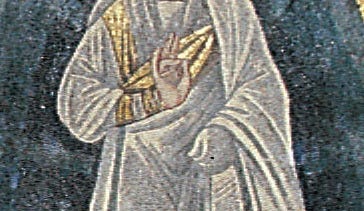
It’s from a point just under that cloaked hand, where the folds of the garment create a pocket of grey, that seven rays of light shoot forth, touching each of the other figures and the names of the two prophets. This is an amazing moment in the history of mosaic representations, as the artists have taken pains to arrange the stones to materialize changes in luminosity. Here is a detail from the great exhibition catalogue Holy Image, Hallowed Ground: Icons from Sinai that my colleague Robert Nelson put together with Kristen Collins at the Getty in 2006:
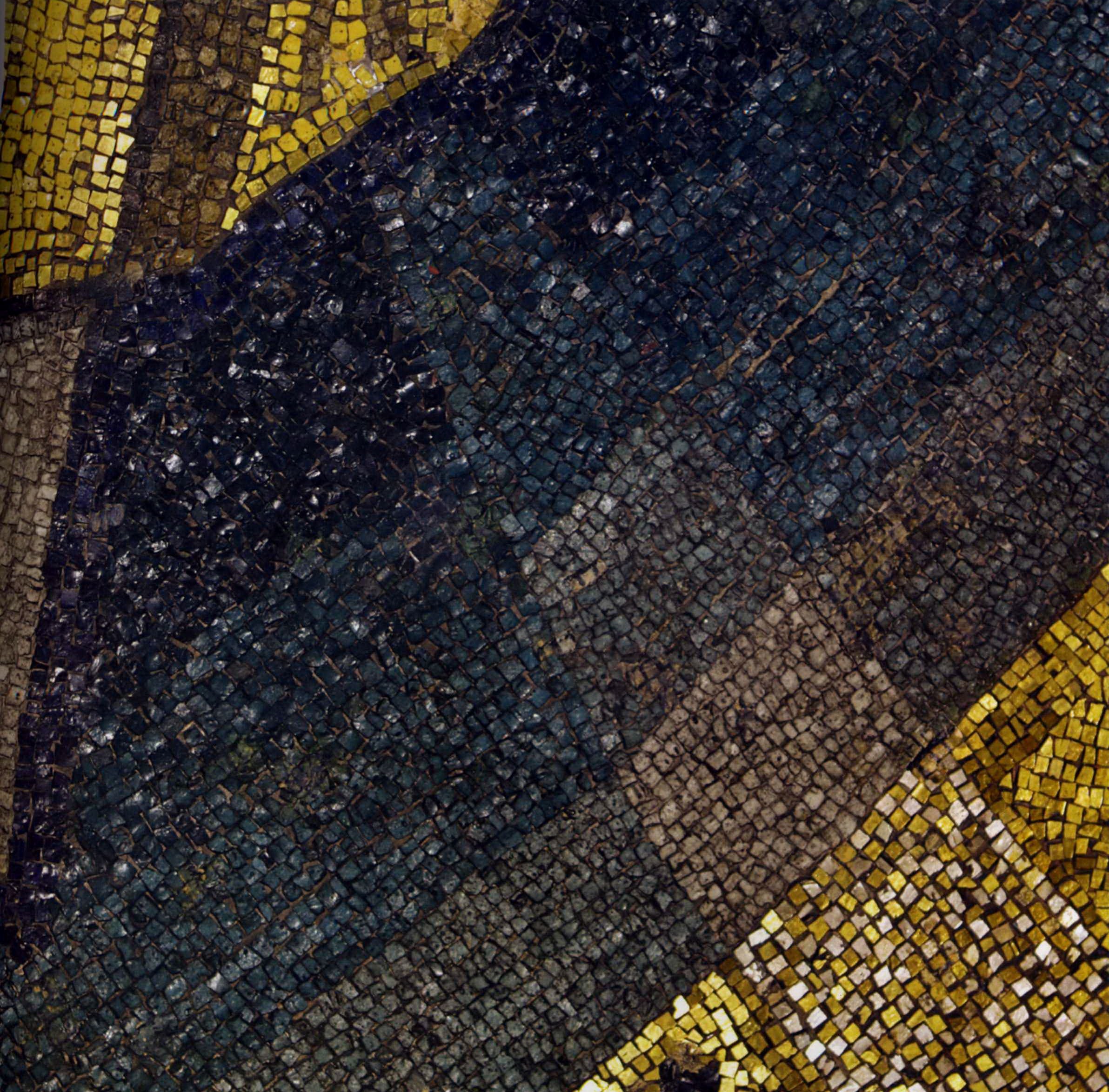
What’s so astonishing is how the artists played the simulated light of the blue and brown stones in the mandorla against the actual sheen of the gold tesserae beyond. Their top surfaces are angled to catch the light in diverse ways. Look at how the curvature of the apse makes the gold ground (by this I mean the whole surface, not the ground-line) shine:
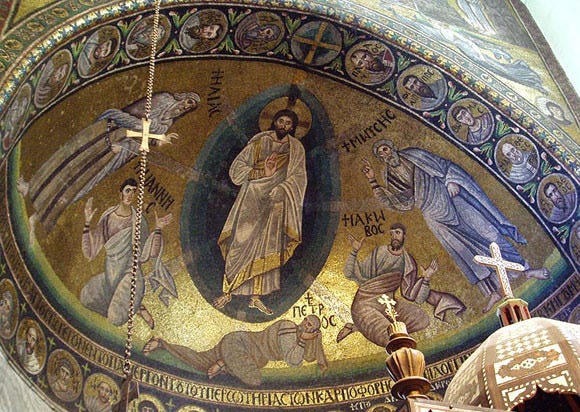
From this angle, taken near the front corner of the altar inside the sanctuary, it’s Peter, on the ground, who pops out most, against light that seems to be spilling from around Christ’s feet. In the image we saw above, taken from deep in the apse directly below the mosaic, the light glows around Christ’s head and shoulders. In this next one, made from a little farther back . . .
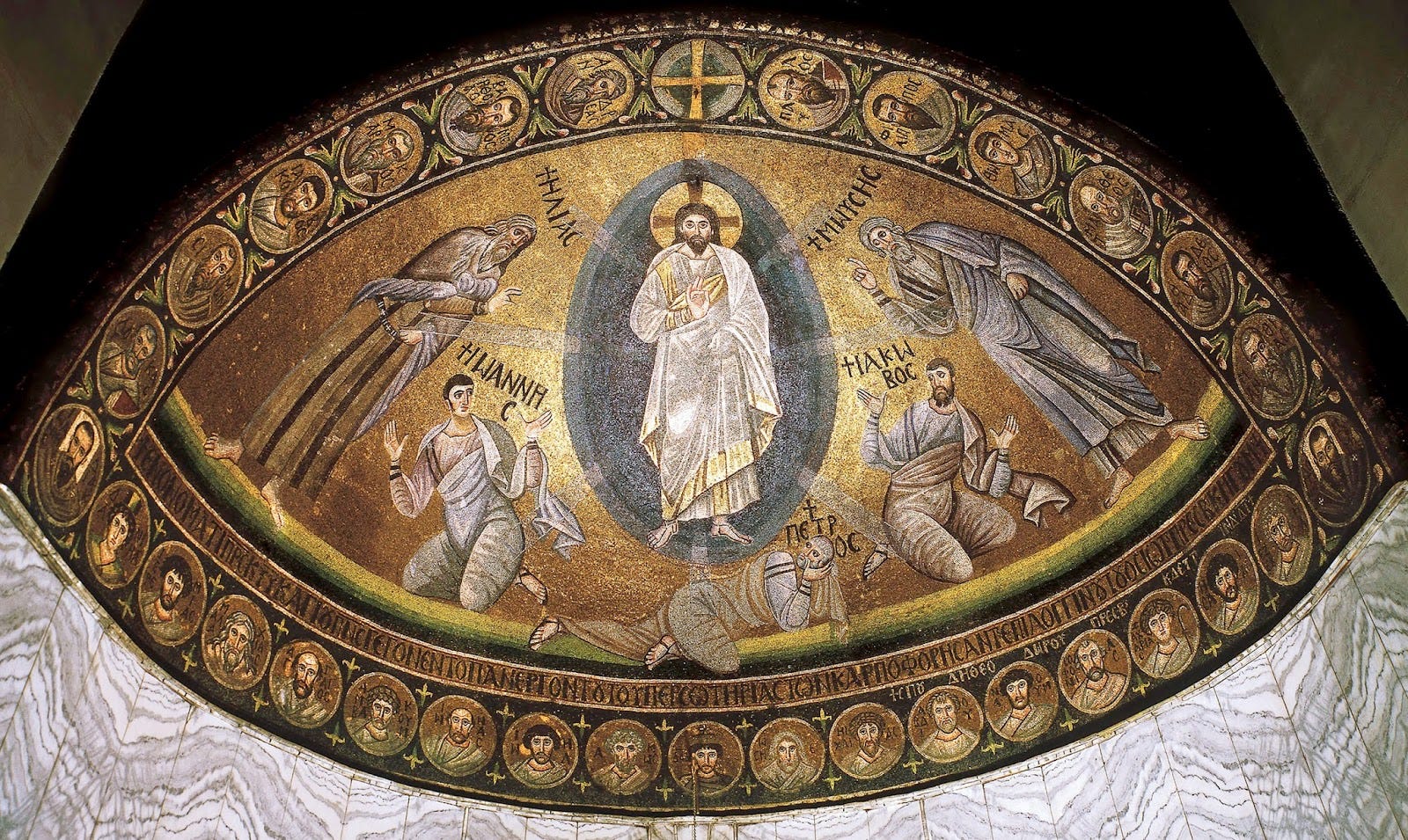
. . . the glow from the middle part of his body extends toward the faces of James and John. The point is that, by virtue of its own shining materials and the curvature of the surface, the mosaic itself is constantly in a state of transfiguration and flux. It looks different from different angles — and changes even more over the course of the day, as the light falls in (or recedes) from the windows overhead.
This is not even to speak of the way that, because of the curved surface, the figures around Christ seem to change and morph depending on where you stand. The apostles look quite compressed in the closer views, marginal characters around Christ’s iconic body — but from farther away and oblique angles (as above), and definitely from an elevated standpoint, they appear stretched into very large scale. Check out this view from scaffolding, where we also see the upper part of the chancel wall, with images of Moses removing his sandals before the Burning Bush, and then receiving the Ten Commandments on the mountain:
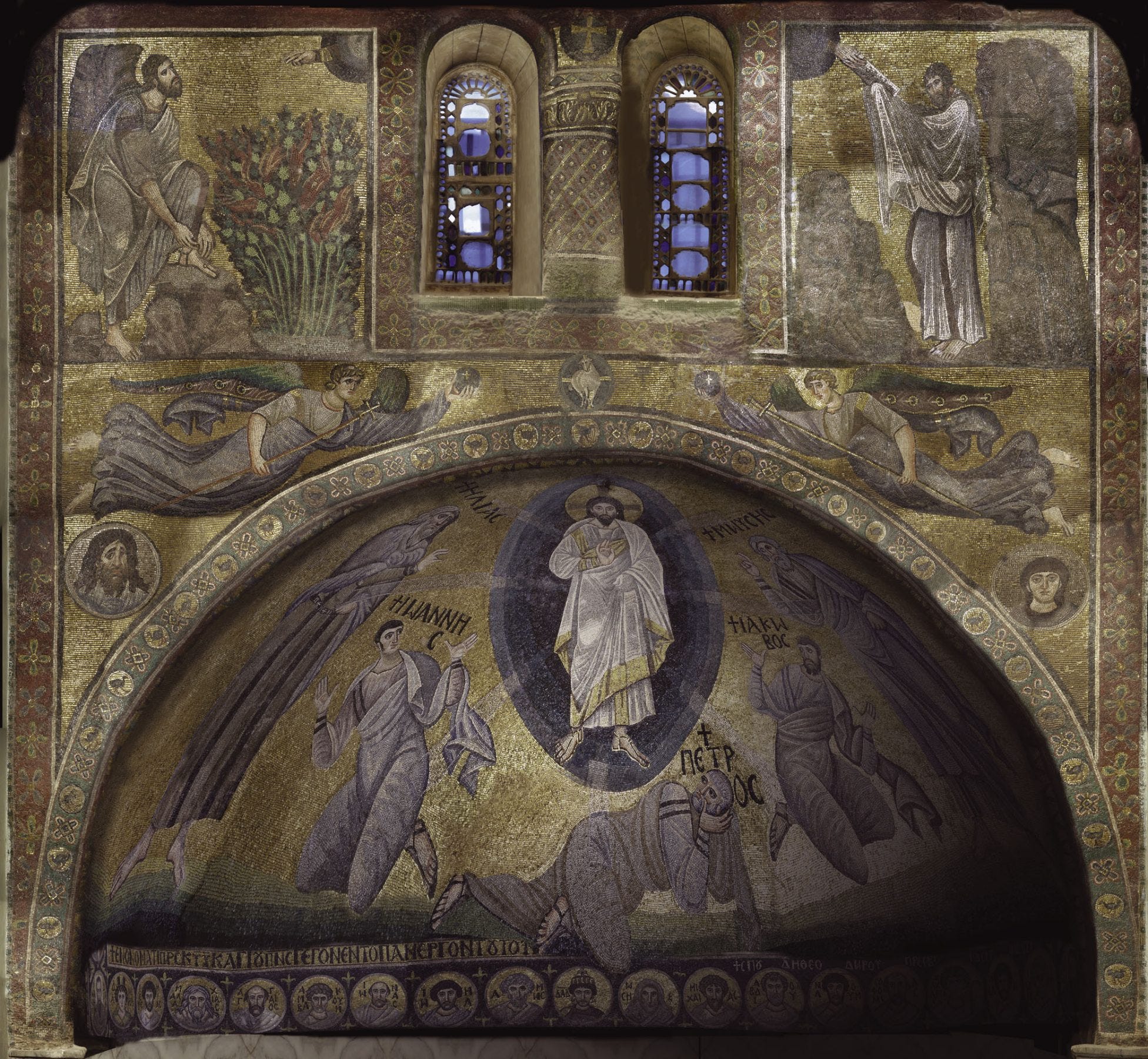
In this sense the image reverses the transfiguration of the story. The other characters — the witnesses and testifiers — morph and change, while only the figure of Christ holds steady, floating above it all and glowing bright, in garments white like sparkling snow.
When I arrived at the Mt. Sinai monastery with our small group of students and faculty back in January, I was super-excited to witness all this for myself. “At last,” I thought, “I can get my own pictures of the mosaic in all its permutations!” No such luck. It’s not only that the church is in regular use for the liturgical prayers (of course!), but also that the new (“new”— like from the seventeenth century) installation of hanging lamps, an icon screen, and a huge painted crucifix almost completely block your view from outside the sanctuary. Here is the clearest I was able to see the mosaic, when a light was turned on for a few moments following a nighttime service:
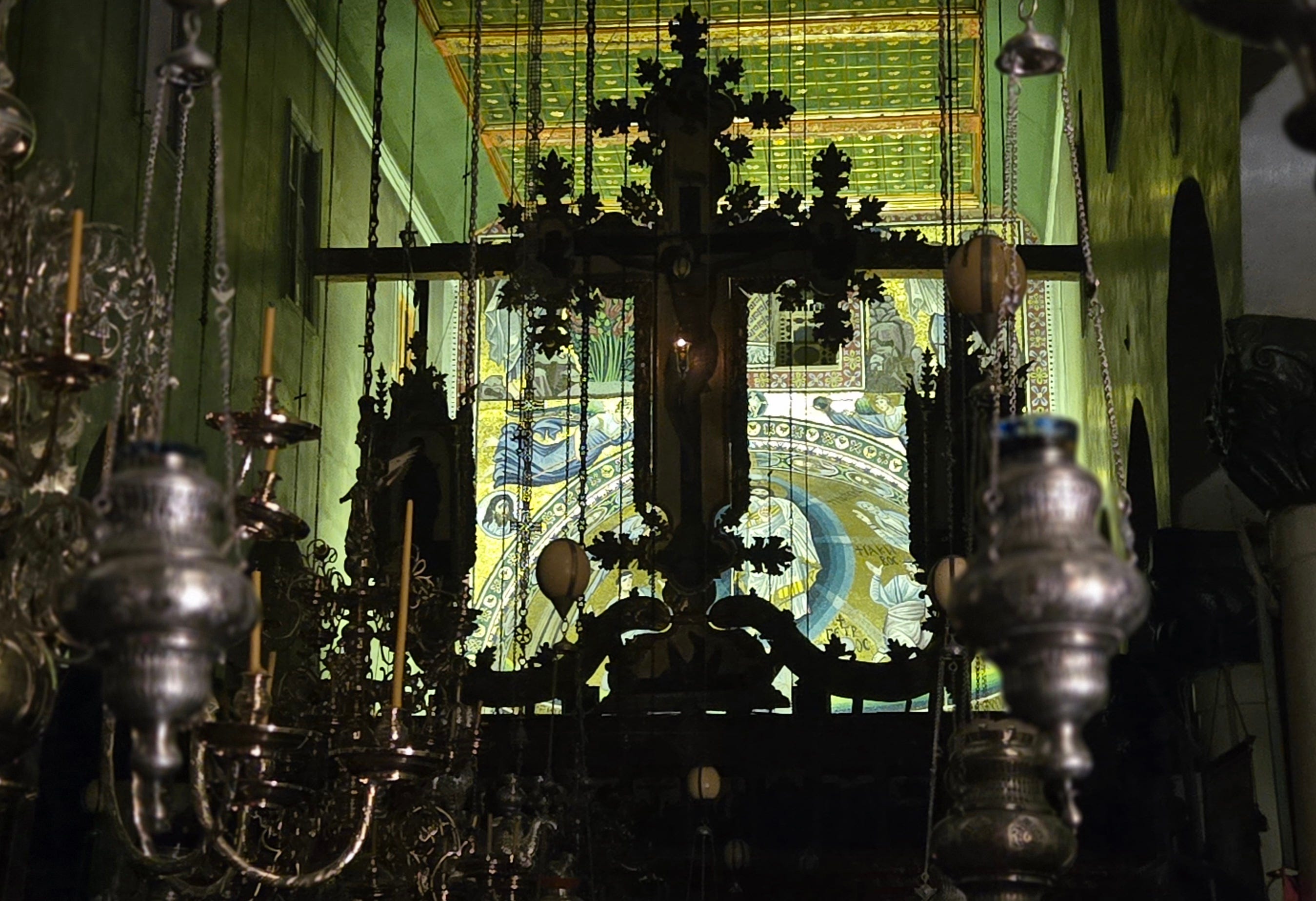
Normally I’d be disappointed to travel so far and not be able to see up close the image I most yearned for. But in the context of that incredibly profound and beautiful church environment, saturated with the sweet smell of incense and reverberating with the voices of the chanting monks, it was fine. Better, even. Deep in a sacred zone that was off-limits to outsides, shaded and obstructed by paraphernalia, with small passages of the image sliding into natural light during morning services and then retreating into darkness, the image’s whole situation let me experience something of the wonder and mystery it depicted. I could only glimpse it in fragments but I knew what was there. I thought of the apostles as they stumbled back down the mountain still stunned by the spectacle, and knowing that they couldn’t tell anyone about it. The truth was present but hidden, like the brightness of Jesus’s clothes masked by the ordinary dust of the world. To see the mosaic this way, I realized, is not not to see it. It’s to see it in a new way, transfigured, with eyes and mind that might just be transformed.
Further reading:
George Galavaris and Marina Myriantheos-Koufopoulou, ed., The Monastery of Mount Sinai and its Sacristy, rev. English edition (Holy Monastery of the God-Trodden Mount Sinai, 2020).
Vladimir Ivanovici, Between Statues and Icons: Iconic Persons from Antiquity to the Early Middle Ages (Paderborn: Brill Schöningh, 2023).
Liz James, Light and Colour in Byzantine Art (Oxford University Press, 1996).
Robert S. Nelson and Kristen M. Collins, ed., Holy Image, Hallowed Ground: Icons from Sinai (Los Angeles: J. Paul Getty Museum, 2006) — especially the essays by Nelson, “Where God Walked and Monks Pray,” 1-37, and Collins, “Visual Piety and Institutional Identity at Sinai,” 95-119.
Superb essay . . . illuminating! And let's hope the mosaic remains half-hidden forever, or at least long enough for the "Transfigurations" shopping mall to erect its own, 3D simulation. Maybe then the world can leave the monks in peace.